







The Night Shift: How Your Gut and Brain Connect During Sleep


 Martha Carlin
| Sep 02, 2026 |
Martha Carlin
| Sep 02, 2026 |

We tend to judge sleep by what happens the next morning. Can we think clearly? Do we have energy? How quickly do we reach for coffee?
But I find the work happening while we sleep just as interesting. Behind closed eyes, the brain is carrying out a carefully coordinated night shift. And research into the microbiome raises an intriguing question: how might the activity in our gut influence the sleep that gives this work its opportunity?
Looking at the body as an interconnected system changes the questions we ask. Alongside “How can I fall asleep?” we can ask, “What helps my body settle into restorative sleep?”
You may have heard that sleep is when the brain “takes out the trash.” That phrase describes research into the glymphatic system, a network of fluid transport pathways involved in clearing waste from brain tissue.
Like every busy organ, the brain produces metabolic waste. Cerebrospinal fluid—the fluid surrounding the brain and spinal cord—exchanges with fluid between brain cells, helping carry away dissolved substances. In a landmark mouse study, researchers found that sleep increased this exchange and the clearance of beta-amyloid, a protein studied in Alzheimer’s disease. Xie and colleagues, Science, 2013.
The maintenance-crew metaphor is useful. But newer research suggests that the crew depends on a surprisingly precise rhythm.
A 2025 study in mice found that during non-REM sleep, slow fluctuations in norepinephrine coordinated changes in blood vessel volume and cerebrospinal fluid movement. Those vessel movements helped pump fluid through the brain. The organization of sleep itself mattered to this process. Hauglund and colleagues, Cell, 2025.
Researchers studying people have also observed coordinated waves of electrical brain activity, blood oxygenation, and cerebrospinal fluid during non-REM sleep. That study documented fluid movement; it did not directly measure waste removal. Fultz and colleagues, Science, 2019.
There is still debate about exactly how sleep affects clearance. A 2024 mouse study using a different measurement approach reported reduced clearance during sleep. The science is developing, and the familiar “taking out the trash” explanation is a simplified picture of a complex process. Miao and colleagues, Nature Neuroscience, 2024.
For me, that complexity makes sleep more interesting. There is an entire choreography happening beneath the surface.
So where does the gut fit in?
One useful place to look is at what microbes make. As bacteria process food, they produce small molecules called metabolites. Some of these molecules participate in signaling beyond the digestive tract.
Take butyrate, a short-chain fatty acid produced when certain gut bacteria ferment dietary fiber. In a rodent study, researchers found that administering a butyrate-releasing compound to mice, or delivering butyrate into the portal circulation in rats, increased non-REM sleep. The findings suggest that signals originating around the gut and liver can influence sleep. They do not establish that eating more fiber or taking a probiotic produces the same effect in people. Szentirmai and colleagues, Scientific Reports, 2019.
Human research offers another piece of the picture. A small observational study found that greater gut microbiome diversity was associated with longer total sleep time and better sleep efficiency. An association cannot tell us whether the microbes improved sleep, sleep supported the microbes, or other factors affected both. But it gives researchers a reason to keep investigating. Smith and colleagues, PLOS ONE, 2019.
This is the connection I find compelling: microbial activity may influence sleep, and sleep is linked to the brain’s fluid dynamics and maintenance processes. That does not yet establish that changing the microbiome improves glymphatic clearance in humans. The pieces are worth studying together, while being clear about what remains unproven.
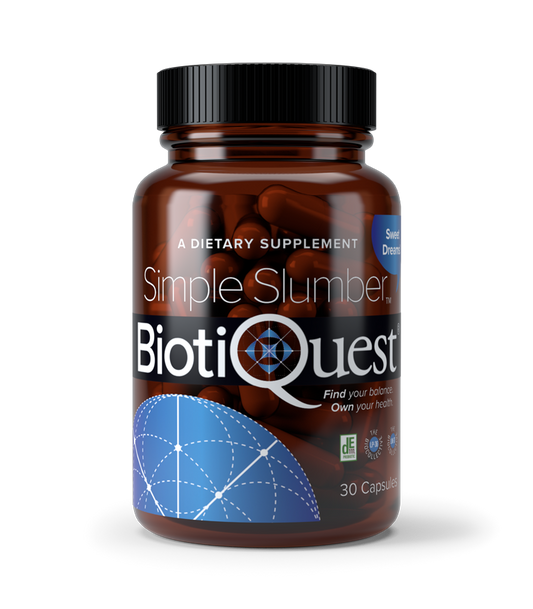
 That interest in microbial function is also part of the thinking behind Simple Slumber™.
We developed Simple Slumber as a six-strain probiotic formula designed to support gut–brain signaling and restful sleep. Our approach considers how bacteria work together and the compounds they can produce as a community.
Its intended role is to support the gut side of the sleep equation. The glymphatic studies discussed here did not test Simple Slumber, and they should not be read as evidence that it clears brain waste or prevents neurological disease.
For everyday life, I would start with giving sleep a dependable place in the day. Keep a consistent sleep and wake schedule. Spend time outside and move during daylight hours. Let the hour before bed become quieter and dimmer, and keep the bedroom cool and dark. Avoid large meals close to bedtime, and pay attention to how caffeine affects you.
There is no need to turn bedtime into another performance test. Choose one routine you can repeat. Give your body time to respond.
What I hope we take from this research is a little more respect for the work of rest. The hours we spend sleeping have a purpose of their own. Protecting them gives the body time for work we cannot consciously do for it.
With gratitude,

 Martha Carlin, is a “Citizen Scientist”,
systems thinker, wife of Parkinson’s warrior, John Carlin, and founder of The BioCollective , a microbiome company expanding
the reach of science and BiotiQuest, the first of it’s kind probiotic line. Since John’s diagnosis in 2002,
Martha began learning the science of agriculture, nutrition, environment, infectious disease, Parkinson’s
pathology and much more. In 2014, when the first research was published showing a connection between the gut
bacteria and the two phenotypes of Parkinson’s, Martha quit her former career as a business turnaround expert
and founded The BioCollective to accelerate the discovery of the impact of gut health on all human disease. Martha was a speaker at the White House 2016 Microbiome Initiative launch, challenging the scientific
community to “think in a broader context”. Her systems thinking background and experience has led to collaborations
across the scientific spectrum from neuroscience to engineering to infectious disease. She is a respected out of the
box problem solver in the microbiome field and brings a unique perspective to helping others understand the
connections from the soil to the food to our guts and our brains.
Martha Carlin, is a “Citizen Scientist”,
systems thinker, wife of Parkinson’s warrior, John Carlin, and founder of The BioCollective , a microbiome company expanding
the reach of science and BiotiQuest, the first of it’s kind probiotic line. Since John’s diagnosis in 2002,
Martha began learning the science of agriculture, nutrition, environment, infectious disease, Parkinson’s
pathology and much more. In 2014, when the first research was published showing a connection between the gut
bacteria and the two phenotypes of Parkinson’s, Martha quit her former career as a business turnaround expert
and founded The BioCollective to accelerate the discovery of the impact of gut health on all human disease. Martha was a speaker at the White House 2016 Microbiome Initiative launch, challenging the scientific
community to “think in a broader context”. Her systems thinking background and experience has led to collaborations
across the scientific spectrum from neuroscience to engineering to infectious disease. She is a respected out of the
box problem solver in the microbiome field and brings a unique perspective to helping others understand the
connections from the soil to the food to our guts and our brains.


Waking Up to a Probiotic Breakfast Can Do Wonders for Your Gut Health
Martha Carlin
| Aug 03, 2022 | 5 minutes read
Did you know that recent studies show people with poor gut diversity had lower quality of life? The health of your microbiome impacts your mental health, sleep, energy, the risk for chronic illnesses, and much more. A probiotic breakfast can...
 gut immunity

Can Probiotic Supplements Make or Break Your Fast?
Martha Carlin
| Dec 14, 2022 | 5 minutes read
Intermittent fasting (IF) may have started as a fitness trend for weight loss, but today it's a go-to lifestyle choice for many. Practicing intermittent fasting has been linked with health benefits such as lowering blood sugar and insulin, preventing heart...
gut immunity


