







Stress Isn't Just in Your Head: How Chronic Stress Reshapes the Microbiome


 Martha Carlin
| Aug 05, 2026 |
Martha Carlin
| Aug 05, 2026 |

Stress has become so common that many of us wear it like a badge of honor. We juggle work, family, caregiving, finances, and the endless stream of information that fills our days. We often think of stress as a mental or emotional experience, but the reality is that stress is profoundly biological.
Every stressful experience sends signals throughout your body. Your heart rate changes. Your hormones shift. Your immune system responds. And one of the first places these signals arrive is in your gut.
The microbiome—the diverse community of trillions of bacteria, fungi, and other microorganisms living primarily in the digestive tract—is constantly listening to these signals. When stress becomes chronic, the microbiome changes in ways that can influence digestion, immunity, metabolism, inflammation, and even mood.
Understanding this relationship helps explain why managing stress isn't simply about feeling calmer. It's about protecting one of the most important ecosystems in your body.
Your Gut and Brain Are in Constant Conversation
Scientists often refer to the gut-brain axis, a two-way communication network connecting the brain, nervous system, immune system, endocrine system, and microbiome.
The brain influences the gut through hormones and the autonomic nervous system. At the same time, gut microbes produce hundreds of compounds that influence the brain, including neurotransmitters, short-chain fatty acids, vitamins, and immune signaling molecules.
This communication happens every second of every day.
When we're under stress, the brain activates the hypothalamic-pituitary-adrenal (HPA) axis, releasing cortisol and other stress hormones. These hormones don't just affect our thoughts—they alter the environment inside the gut.
What Chronic Stress Does to the Microbiome
A short period of stress is a normal part of life. Healthy microbiomes are remarkably resilient.
The problem arises when stress becomes chronic.
Persistent stress has been shown to:
- Reduce microbial diversity
- Decrease populations of beneficial bacteria
- Increase intestinal permeability ("leaky gut")
- Alter immune function
- Increase inflammatory signaling
- Change gut motility and digestion
- Affect production of beneficial microbial metabolites
One of the most consistent findings in microbiome research is that loss of microbial diversity is associated with poorer health outcomes.
Stress appears to accelerate this loss.
Think of your microbiome like a rainforest. A diverse ecosystem is resilient. It can recover from storms, adapt to change, and continue supporting life. But when diversity declines, the ecosystem becomes increasingly fragile.
The same principle applies inside the human gut.
Cortisol Changes More Than Your Mood
Cortisol often gets labeled as the "stress hormone," but its job is much more complex. It helps regulate metabolism, blood sugar, inflammation, and the body's response to challenge. Problems arise when cortisol remains elevated for weeks, months, or even years.
Chronically high cortisol can:
- Reduce mucus production that protects the intestinal lining
- Alter the gut environment in ways that favor less desirable microbes
- Suppress healthy immune surveillance
- Increase intestinal permeability
- Contribute to chronic low-grade inflammation
These changes don't happen in isolation. They reinforce one another.
As the gut barrier weakens, inflammatory molecules can enter circulation more easily, placing additional stress on the immune system and creating a cycle that's difficult to break.
Your Microbes Also Respond to Your Emotions
One of the most fascinating discoveries in microbiome science is that microbes appear capable of sensing stress-related chemicals released by the body.
Certain bacteria can detect hormones like norepinephrine and alter their behavior in response. Some become more active. Others change how they grow or interact with neighboring microbes.
In other words, your microbiome is not simply affected by stress, it is actively responding to it.
This emerging field, sometimes called microbial endocrinology, is revealing just how interconnected our internal ecosystems truly are.
Stress Can Change What You Eat—and Your Microbes Notice
Stress influences the microbiome indirectly as well.
Many people under chronic stress:
- Sleep less
- Exercise less
- Eat fewer fiber-rich foods
- Reach for ultra-processed foods or sugary snacks
- Drink more alcohol
- Spend less time outdoors
Each of these behaviors independently affects the microbiome.
This doesn't mean stress automatically leads to poor health. Rather, stress often changes the daily habits that nourish our microbial communities.
The encouraging news is that small improvements can begin moving things back in the right direction.
The Good News: The Microbiome Is Remarkably Adaptable
Unlike our genes, the microbiome is dynamic. Even after periods of stress, many microbial communities can recover when conditions improve.
Research suggests several habits consistently support microbial resilience:
Feed Your Microbes
Fiber is the primary fuel for many beneficial gut bacteria.
Aim to eat a wide variety of plant foods—vegetables, fruits, legumes, nuts, seeds, herbs, spices, and whole grains. Different microbes specialize in different fibers, so diversity on your plate helps build diversity in your gut.
Prioritize Sleep
Sleep and the microbiome have a reciprocal relationship.
Poor sleep alters microbial composition, while an unhealthy microbiome may contribute to disrupted sleep quality. Supporting one often helps improve the other.
Move Your Body
Regular physical activity has been associated with increased microbial diversity and greater production of beneficial short-chain fatty acids.
The goal isn't perfection. Consistency matters far more than intensity.
Spend Time in Nature
Exposure to natural environments introduces us to beneficial environmental microbes while simultaneously lowering stress hormones.
Gardening, walking through forests, or simply spending time outdoors may support both emotional well-being and microbial diversity.
Practice Stress Recovery
Eliminating stress isn't realistic. Learning how to recover from stress is.
Meditation, deep breathing, mindfulness, social connection, laughter, prayer, and time with loved ones all help regulate the nervous system and may indirectly support a healthier gut environment.
 Consider Targeted Probiotics

Not all probiotics are the same. Some strains have demonstrated the ability to help support the gut barrier, modulate immune function, or promote production of beneficial compounds during times of physiological stress.
Because every microbiome is unique, choosing probiotic strains with documented mechanisms and clinical research is more important than simply selecting products with the highest number of organisms.
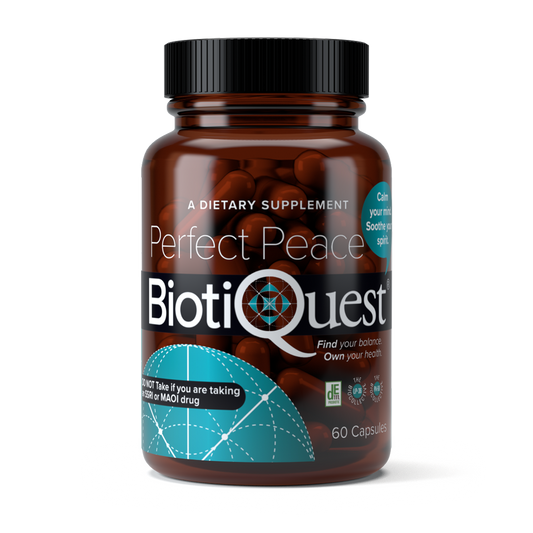
We created our Perfect Peace™ formula to help ease the weight that modern life places on the mind and body. Today’s world brings a constant stream of stressors — from busy schedules and digital overload to environmental pressures — all of which can quietly strain our gut-brain connection and tip us out of balance.
Check out this review of Perfect Peace from a customer, Jennifer Q who also shared her Aura Ring results!


Building Resilience From the Inside Out
Stress is an unavoidable part of being human. But chronic stress doesn't have to define our health.
Every meal, every walk outside, every good night's sleep, every moment of connection, and every effort to care for the microbiome helps strengthen one of the body's most important systems.
The goal isn't to eliminate every source of stress. It's to build resilience.
Our microbiome is one of the body's greatest allies in that process. When we care for it, we're not just supporting digestion—we're supporting the intricate network connecting the gut, brain, immune system, metabolism, and overall well-being.
In many ways, resilience begins in the gut.
References
Cryan JF, O'Riordan KJ, Cowan CSM, et al. The Microbiota-Gut-Brain Axis. Physiological Reviews. 2019.
Foster JA, Rinaman L, Cryan JF. Stress & the gut-brain axis: Regulation by the microbiome. Neurobiology of Stress. 2017.
Konturek PC, Brzozowski T, Konturek SJ. Stress and the gut: Pathophysiology, clinical consequences, diagnostic approach and treatment options. Journal of Physiology and Pharmacology. 2011.
Mayer EA, Knight R, Mazmanian SK, Cryan JF, Tillisch K. Gut microbes and the brain: Paradigm shift in neuroscience. Journal of Neuroscience. 2014.
De Palma G, Collins SM, Bercik P, Verdu EF. The microbiota-gut-brain axis in gastrointestinal disorders. Gut Microbes. 2014.
With gratitude,

 Martha Carlin, is a “Citizen Scientist”,
systems thinker, wife of Parkinson’s warrior, John Carlin, and founder of The BioCollective , a microbiome company expanding
the reach of science and BiotiQuest, the first of it’s kind probiotic line. Since John’s diagnosis in 2002,
Martha began learning the science of agriculture, nutrition, environment, infectious disease, Parkinson’s
pathology and much more. In 2014, when the first research was published showing a connection between the gut
bacteria and the two phenotypes of Parkinson’s, Martha quit her former career as a business turnaround expert
and founded The BioCollective to accelerate the discovery of the impact of gut health on all human disease. Martha was a speaker at the White House 2016 Microbiome Initiative launch, challenging the scientific
community to “think in a broader context”. Her systems thinking background and experience has led to collaborations
across the scientific spectrum from neuroscience to engineering to infectious disease. She is a respected out of the
box problem solver in the microbiome field and brings a unique perspective to helping others understand the
connections from the soil to the food to our guts and our brains.
Martha Carlin, is a “Citizen Scientist”,
systems thinker, wife of Parkinson’s warrior, John Carlin, and founder of The BioCollective , a microbiome company expanding
the reach of science and BiotiQuest, the first of it’s kind probiotic line. Since John’s diagnosis in 2002,
Martha began learning the science of agriculture, nutrition, environment, infectious disease, Parkinson’s
pathology and much more. In 2014, when the first research was published showing a connection between the gut
bacteria and the two phenotypes of Parkinson’s, Martha quit her former career as a business turnaround expert
and founded The BioCollective to accelerate the discovery of the impact of gut health on all human disease. Martha was a speaker at the White House 2016 Microbiome Initiative launch, challenging the scientific
community to “think in a broader context”. Her systems thinking background and experience has led to collaborations
across the scientific spectrum from neuroscience to engineering to infectious disease. She is a respected out of the
box problem solver in the microbiome field and brings a unique perspective to helping others understand the
connections from the soil to the food to our guts and our brains.

Waking Up to a Probiotic Breakfast Can Do Wonders for Your Gut Health
Martha Carlin
| Aug 03, 2022 | 5 minutes read
Did you know that recent studies show people with poor gut diversity had lower quality of life? The health of your microbiome impacts your mental health, sleep, energy, the risk for chronic illnesses, and much more. A probiotic breakfast can...
 gut immunity

Can Probiotic Supplements Make or Break Your Fast?
Martha Carlin
| Dec 14, 2022 | 5 minutes read
Intermittent fasting (IF) may have started as a fitness trend for weight loss, but today it's a go-to lifestyle choice for many. Practicing intermittent fasting has been linked with health benefits such as lowering blood sugar and insulin, preventing heart...
gut immunity


