







How Gut Bacteria Influence Stress and the Nervous System


 Martha Carlin
| Mar 05, 2026 |
Martha Carlin
| Mar 05, 2026 |

We’ve all felt it: that sudden, cold knot in the stomach the second a stressful email hits your inbox. We usually blame our brains for that panic, but it turns out your gut isn't just reacting to the stress—it might be driving it.
Think of your microbiome less like a passenger and more like a co-pilot. When those trillions of bacteria are balanced, things stay chill. When they’re out of whack? They can crank the volume on your stress hormones before you even realize what’s happening.
The HPA Axis: Your Internal Command Chain
When you encounter a stressor, your body activates the HPA axis: a communication line between the hypothalamus, pituitary, and adrenal glands.
This system functions like a relay. The hypothalamus starts the signal, the pituitary passes it on, and the adrenal glands finish by releasing cortisol. Cortisol isn't the enemy; it’s a survival tool that sharpens focus and mobilizes energy. However, when the signal never turns off, the system strains. Sleep shifts, mood wavers, and blood sugar becomes harder to regulate.
This is where gut bacteria enter the picture. Certain microbes, such as Bifidobacterium longum, help modulate this response, ensuring the "alarm" only rings when it’s actually appropriate.
Neurotransmitters: The Microbial Assist
We often imagine neurotransmitters are made exclusively in the brain, but the gut is a major production hub for these chemical messengers. Microbes help convert nutrients into compounds that directly influence our state of mind:
- Serotonin: Linked to mood stability.
- Dopamine: Tied to motivation and reward.
- GABA: The nervous system’s primary "brake."
Without adequate GABA signaling, excitatory compounds like glutamate can keep the nervous system stuck in high gear. Strains like Lactobacillus rhamnosus act as natural regulators for these pathways. If these microbial levels drop, your internal "cooling system" fails, and stress signals start to redline. The goal isn't to force a mood shift—it’s to fix the biological hardware so your body can regulate itself.
The Gut Lining: Your Immune Security
The gut lining is the physical barrier between the external world (food, toxins, microbes) and your internal environment.
When this barrier is strong, it’s a selective filter. When it’s compromised, inflammatory signals can leak into your circulation. This "background noise" triggers immune responses that interfere with brain function and mood.
Beneficial metabolites like butyrate—produced by microbes—act as the primary fuel for a healthy gut lining. Strains such as Lactobacillus plantarum reinforce these "tight junctions." By reducing unnecessary immune activation, you create a quieter environment for your nervous system to operate.
A Systems Approach to Resilience
 At BiotiQuest, we formulate probiotics the way nature designs ecosystems: through cooperation, not isolation.
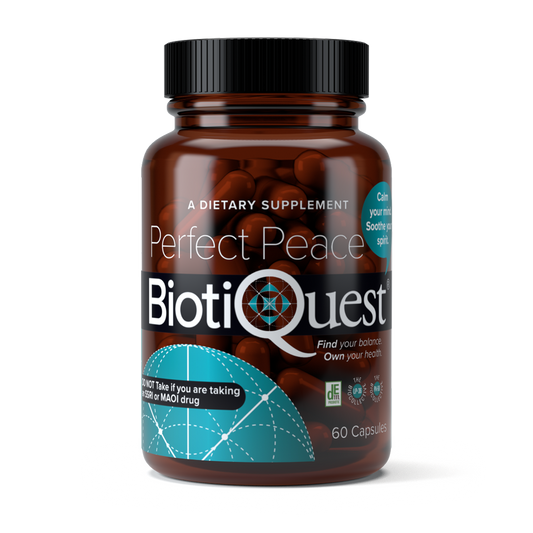
Our Perfect Peace formula was developed to support this entire network, from HPA axis signaling to neurotransmitter production and barrier integrity. We think of it less as “calming the mind” and more as tuning an orchestra. Each strain plays a different part; when they’re coordinated, the result isn’t sedation—it’s harmony.
Moving Beyond the Alarm
Stress is not just an emotional experience; it’s a whole-body event. While chronic stress can lead to fatigue, the encouraging truth is that the microbiome is adaptable. It responds to diet, sleep, and targeted probiotic support.
If you’re navigating mood fluctuations or sleep disruption, I encourage you to look at the ecosystem, not just the alarm. Calm is not something we force; it’s something we build by strengthening the systems that carry the signal.
With gratitude,

 Martha Carlin, is a “Citizen Scientist”,
systems thinker, wife of Parkinson’s warrior, John Carlin, and founder of The BioCollective , a microbiome company expanding
the reach of science and BiotiQuest, the first of it’s kind probiotic line. Since John’s diagnosis in 2002,
Martha began learning the science of agriculture, nutrition, environment, infectious disease, Parkinson’s
pathology and much more. In 2014, when the first research was published showing a connection between the gut
bacteria and the two phenotypes of Parkinson’s, Martha quit her former career as a business turnaround expert
and founded The BioCollective to accelerate the discovery of the impact of gut health on all human disease. Martha was a speaker at the White House 2016 Microbiome Initiative launch, challenging the scientific
community to “think in a broader context”. Her systems thinking background and experience has led to collaborations
across the scientific spectrum from neuroscience to engineering to infectious disease. She is a respected out of the
box problem solver in the microbiome field and brings a unique perspective to helping others understand the
connections from the soil to the food to our guts and our brains.
Martha Carlin, is a “Citizen Scientist”,
systems thinker, wife of Parkinson’s warrior, John Carlin, and founder of The BioCollective , a microbiome company expanding
the reach of science and BiotiQuest, the first of it’s kind probiotic line. Since John’s diagnosis in 2002,
Martha began learning the science of agriculture, nutrition, environment, infectious disease, Parkinson’s
pathology and much more. In 2014, when the first research was published showing a connection between the gut
bacteria and the two phenotypes of Parkinson’s, Martha quit her former career as a business turnaround expert
and founded The BioCollective to accelerate the discovery of the impact of gut health on all human disease. Martha was a speaker at the White House 2016 Microbiome Initiative launch, challenging the scientific
community to “think in a broader context”. Her systems thinking background and experience has led to collaborations
across the scientific spectrum from neuroscience to engineering to infectious disease. She is a respected out of the
box problem solver in the microbiome field and brings a unique perspective to helping others understand the
connections from the soil to the food to our guts and our brains.

Waking Up to a Probiotic Breakfast Can Do Wonders for Your Gut Health
Martha Carlin
| Aug 03, 2022 | 5 minutes read
Did you know that recent studies show people with poor gut diversity had lower quality of life? The health of your microbiome impacts your mental health, sleep, energy, the risk for chronic illnesses, and much more. A probiotic breakfast can...
 gut immunity

Can Probiotic Supplements Make or Break Your Fast?
Martha Carlin
| Dec 14, 2022 | 5 minutes read
Intermittent fasting (IF) may have started as a fitness trend for weight loss, but today it's a go-to lifestyle choice for many. Practicing intermittent fasting has been linked with health benefits such as lowering blood sugar and insulin, preventing heart...
gut immunity


