







Glyphosate, Accountability, and the System We’ve Built


 Martha Carlin
| May 07, 2026 |
Martha Carlin
| May 07, 2026 |

I’ve been sitting with a lot this past week as I watched things unfold in Washington, DC.
Not just because glyphosate is back in the headlines again, but because of what it represents—and how long this has been building. I feel this is a very important moment in time.
There is a Supreme Court case underway that could shape how liability is handled for glyphosate, and whether the federal government can impose liability protections on states that may not want to protect these companies. At the same time, Congress has been considering whether to include blanket liability protections for glyphosate manufacturers in the farm bill—protections similar to what vaccine makers have. And more recently, the administration signed an Executive Order framing key agricultural inputs, including glyphosate, as a matter of national security.
Close to 300,000,000 pounds of glyphosate is used every year on crops in the U.S. alone. It was initially used primarily in corn and soy, but is now used in the drying process of more than 60 crops at the end of harvest, leaving behind even higher residues.
You may have seen the headlines on lawsuits related to lymphoma over the past few years. That is very likely the tip of the iceberg when you understand how deeply the chemical affects our entire ecosystems from the soil microbiome to the human microbiome, both critical players in our overall health.
When you step back and look at that, it lands differently.
Because this isn’t just about one chemical. It’s about how deeply embedded this system has become, and how difficult it is to even question it once it reaches that level. Many financial interests are at stake and converting our farming systems away from this approach won’t be an easy or fast task.
At the same time, there were people standing outside the Supreme Court last week at the People vs. Poison protest. It was organized by Vani Hari, the Food Babe, alongside leaders like Zen Honeycutt of Moms Across America. Mothers, farmers, scientists, and advocates gathered because they’ve been watching this issue for years—often long before it reached the level of a Supreme Court case. I’ve been watching it for a long time too.
That contrast is hard to ignore. On one side, discussions about legal protections tied to large-scale farming systems and corporate interests that depend on them. On the other, people asking for accountability in the food system and pointing out the risks to an unsuspecting public.
And in the middle of that are millions of people who are exposed to glyphosate every single day and don’t realize it. I continue to be surprised by how many people have never even heard of it.
I keep coming back to something I talked about in December at the ACRES Conference.
The title of that talk was “Choose Life.”
That phrase came out of years of watching how we approach health, agriculture, and even medicine. We have built a system that defaults to killing. Antibiotics, toxic drugs, herbicides, pesticides—tools that were developed to solve real problems, but that, over time, became the foundation of how we manage biology without thinking about their larger harms in the wider system.
Life is not built through eradication. It’s built through relationships—between microbes, between systems, between the soil and the plants and the people eating those plants. When those relationships are disrupted, the effects don’t always show up immediately. But they show up.
They show up in the soil, which loses structure, water-holding capacity, and the ability to deliver nutrients. They show up in the microbiome—of the soil, plants, animals, and humans. And they show up in rising chronic disease across the system—in weakened plants, animals, and people.
Glyphosate is often treated like a single issue, but it isn’t. It’s a very visible entry point into a much larger pattern.
It interferes with the shikimate pathway in plants and microbes—the pathway that produces aromatic amino acids (phenylalanine, tryptophan and tyrosine) and polyphenols in plants. Those compounds are not optional. The aromatic amino acids are called “essential” for a reason. These aromatic compounds are part of how plants defend themselves, how microbes function, and how we derive resilience from the food we eat. The aromatic amino acids are critical to neurotransmitter production, mental health and more.
When that pathway is disrupted, the ripple effects are real. The nutritional profile of food changes. Microbial communities shift. The body becomes more vulnerable to stress that it would otherwise handle.
And yet, this is happening quietly, in the background, built into the system.
Glyphosate is used not just as a weed killer, but as a pre-harvest drying agent on many crops—including foods people are intentionally choosing because they believe they are healthy. There are now more than 60 crops that use this practice to make harvesting “more efficient”, including many legumes and grains.
For me, this didn’t start with policy. It started with a question. Remember, I’m an auditor by training? Examine the evidence for yourself and ask questions.
In the early days of John’s Parkinson’s diagnosis, I began looking at everything differently. Not just the disease itself, but the inputs—the things that might be contributing in ways we weren’t fully understanding.
John ate soy every day. At the time, Soy was marketed as the ultimate health food.
But soy is also one of the crops most heavily treated with glyphosate. Back when John was first diagnosed in 2002, over 97% of the soy in America was GMO Round-up Ready, meaning engineered to take glyphosate.
I’ve never said that is proof of anything on its own, but it was enough to shift how I was thinking and how we were eating. And that question led to more questions—about agriculture, about the microbiome, about how small, repeated exposures might shape biology over time.
I’ve never let go of my auditor’s mindset when it comes to this chemical.
Over the past decade, my work has been focused on what we can do differently and bringing solutions to light to help solve this problem.
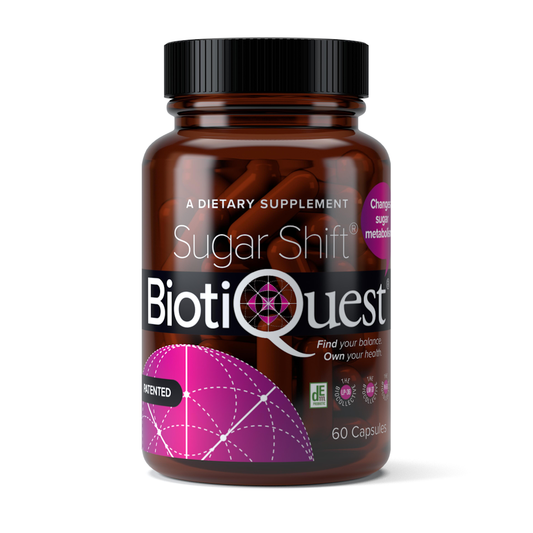
At BiotiQuest, we developed Sugar Shift for John to support microbial balance and metabolic function. But I was also focused on making sure the strains were resistant to glyphosate since it kills most beneficial bacteria like the Lactobacillus and Bifidobacteria. In laboratory testing, the strains in that formulation have shown the ability to reduce glyphosate and its primary metabolite, AMPA, even at concentrations far higher (1000X) than what is typically found in food.
At Ancient Organics BioSciences, our sister company, that Raul Cano leads with our partner Robin Steele, we’ve worked on restoring microbial function in the soil through systems like PaleoPower—because this doesn’t begin in the body. It begins in the ground, in the way we grow food and manage ecosystems. We received a patent for this in 2025.
If we want to change outcomes, we have to look at the system as a whole and we have to work on solutions that help the system as a whole.
I don’t think the answer is panic, and I don’t think it’s pretending this isn’t happening.
I think it’s awareness, followed by better decisions. As you can see from the People vs. Poison protest, our voices have power. When we start to make our voices heard, it gets attention because there are a lot more of US.
The legal landscape around glyphosate will continue to evolve. There will be more cases, more policies, more debates about protections and accountability. No matter how the case shakes out, we have power through the choices we make and through educating others.
Are we building a system that supports life, or one that slowly degrades it?
That’s the question I started asking when I founded The BioCollective.
And it’s the reason I chose that title in December talk at ACRES.
Choose Life.
Not as a slogan, but as a direction.
Because the choices we make—individually and collectively—are shaping outcomes, whether we realize it or not. We can choose life in each of our daily choices, including how we speak to each other and those that we disagree with.
Glyphosate is not the whole story. But it is a place to start paying attention.
With gratitude,

 Martha Carlin, is a “Citizen Scientist”,
systems thinker, wife of Parkinson’s warrior, John Carlin, and founder of The BioCollective , a microbiome company expanding
the reach of science and BiotiQuest, the first of it’s kind probiotic line. Since John’s diagnosis in 2002,
Martha began learning the science of agriculture, nutrition, environment, infectious disease, Parkinson’s
pathology and much more. In 2014, when the first research was published showing a connection between the gut
bacteria and the two phenotypes of Parkinson’s, Martha quit her former career as a business turnaround expert
and founded The BioCollective to accelerate the discovery of the impact of gut health on all human disease. Martha was a speaker at the White House 2016 Microbiome Initiative launch, challenging the scientific
community to “think in a broader context”. Her systems thinking background and experience has led to collaborations
across the scientific spectrum from neuroscience to engineering to infectious disease. She is a respected out of the
box problem solver in the microbiome field and brings a unique perspective to helping others understand the
connections from the soil to the food to our guts and our brains.
Martha Carlin, is a “Citizen Scientist”,
systems thinker, wife of Parkinson’s warrior, John Carlin, and founder of The BioCollective , a microbiome company expanding
the reach of science and BiotiQuest, the first of it’s kind probiotic line. Since John’s diagnosis in 2002,
Martha began learning the science of agriculture, nutrition, environment, infectious disease, Parkinson’s
pathology and much more. In 2014, when the first research was published showing a connection between the gut
bacteria and the two phenotypes of Parkinson’s, Martha quit her former career as a business turnaround expert
and founded The BioCollective to accelerate the discovery of the impact of gut health on all human disease. Martha was a speaker at the White House 2016 Microbiome Initiative launch, challenging the scientific
community to “think in a broader context”. Her systems thinking background and experience has led to collaborations
across the scientific spectrum from neuroscience to engineering to infectious disease. She is a respected out of the
box problem solver in the microbiome field and brings a unique perspective to helping others understand the
connections from the soil to the food to our guts and our brains.

Waking Up to a Probiotic Breakfast Can Do Wonders for Your Gut Health
Martha Carlin
| Aug 03, 2022 | 5 minutes read
Did you know that recent studies show people with poor gut diversity had lower quality of life? The health of your microbiome impacts your mental health, sleep, energy, the risk for chronic illnesses, and much more. A probiotic breakfast can...
 gut immunity

Can Probiotic Supplements Make or Break Your Fast?
Martha Carlin
| Dec 14, 2022 | 5 minutes read
Intermittent fasting (IF) may have started as a fitness trend for weight loss, but today it's a go-to lifestyle choice for many. Practicing intermittent fasting has been linked with health benefits such as lowering blood sugar and insulin, preventing heart...
gut immunity


